Setting up a Phantom wallet takes under five minutes — and understanding every field on each screen makes the process smoother from the very first click. This guide walks you through the full creation flow, explains what every interface element does, and shows how to generate a Phantom wallet UI mockup using Zoobic's online screenshot template editor for demos, tutorials, and content creation.
What Is Phantom Wallet?
"Non-custodial" means you hold your own private keys. No company stores them for you. That single fact is why the setup steps — especially the recovery phrase screen — deserve your full attention.
Step 1: Install the Phantom Browser Extension
Go to phantom.app and click Download. The site detects your browser automatically and redirects you to the appropriate extension store. For Chrome and Brave, that's the Chrome Web Store. For Firefox, it's the Firefox Add-ons page.
Click Add to Browser, then confirm any permissions the browser requests. Once installed, pin the Phantom icon to your browser toolbar — the small icon puzzle-piece menu in Chrome lets you do this with one click.
When you open Phantom for the first time, you'll see two options:
- Create a new wallet — for users setting up Phantom from scratch
- I already have a wallet — for importing an existing seed phrase or private key
Select Create a new wallet to proceed.
Key rules for this field:
- Minimum 8 characters, though longer is stronger
- Mix uppercase, lowercase, numbers, and symbols Type your password, confirm it in the second field, check the terms-of-service box, and click Continue.
Step 3: Secret Recovery Phrase — Read This Carefully
What the screen shows:
- 12 numbered words displayed in a fixed order
- A checkbox confirming you've saved them before proceeding Best practice: write the phrase by hand on paper. Number each word clearly. Store the paper in a secure, offline location. Do not screenshot it, do not paste it into a cloud note, and do not share it with anyone.
Click Continue only after you've recorded all 12 words in the exact sequence shown.
Step 4: Verify Your Recovery Phrase
Phantom asks you to re-enter a selection of words from your phrase in their correct positions. This screen confirms you actually wrote them down rather than skipping past it.
The form shows blank fields for three to four specific word positions (e.g., Word 3, Word 7, Word 11). Type each word exactly as shown in your written record. Capitalization typically doesn't matter, but spelling does.
After verification, the main dashboard loads. Here's what every element on the home screen represents:
Portfolio balance — Shows your total holdings in USD (or your selected fiat currency). Below it, individual token rows list the token name, quantity, and current market value.
Action buttons row — Four main buttons: Receive, Send, Swap, and Buy. Each opens its own screen with specific input fields.
Activity tab — Switches the lower panel to a transaction history list. Each row shows the transaction type, counterparty address (truncated), amount, and a status badge: Confirmed, Pending, or Failed.
Step 6: Sending and Receiving SOL — Every Field Explained
The Send Screen
Click Send to open the send panel. The fields are:
- Amount field: Enter the amount in SOL, or toggle to USD view using the conversion button. The field updates the opposing currency in real time.
- Network fee estimate: Displayed below the amount. Solana fees are typically a fraction of a cent. The number adjusts based on network conditions.
- Review screen: Before final confirmation, Phantom shows a summary of the recipient address, amount, and fee. Verify everything here — transactions on-chain are irreversible.
Click Confirm to broadcast the transaction.
The Receive Screen
Click Receive to open the receive panel. It displays:- Network selector: Lets you specify which blockchain and token type you're expecting (SOL, ETH, BTC, etc.), so the sender uses the correct network.
Sharing your receive address is safe — it's a public key by design.
Step 7: Security Settings to Configure Right After Creation
Before you do anything else with your new wallet, open Settings (the gear icon) and configure these fields:
Auto-lock timer — Found under Security & Privacy. Sets the idle time before Phantom locks and requires your password. Recommended: 1–5 minutes for active use, 1 minute if you're on a shared machine.
Change password — Available in Account settings. The form requires your current password, new password, and confirmation field.
Connect a hardware wallet — If you own a Ledger device, Phantom supports pairing. The connection screen walks you through enabling blind signing on the device and confirming the pairing, adding a physical confirmation step to every transaction.
Step 8: NFTs, Token Swaps, and dApp Connections
NFT tab: Displays collectibles held by your wallet. Each NFT shows its image, collection name, and floor price if available. Clicking an item opens a detail view with metadata fields: name, description, attributes, and mint address.
Swap screen: Click Swap from the dashboard. Fields include:
- From token: Select the asset you're spending
- To token: Select what you want to receive
- Amount: Enter the quantity to swap
- Slippage tolerance: A percentage field (typically 0.5–1%) that sets the maximum acceptable price movement during execution
- Price impact: Calculated automatically — shows how much your swap affects the pool price
- Rate display: Shows the current exchange rate between the two tokens
Review all fields on the confirmation screen before approving.
What Zoobic Offers for This Use Case
Zoobic provides 8,000+ screenshot templates across 300+ categories, including crypto wallet, USDT wallet, and fintech app mockups. The online editor runs entirely in your browser — open app.zoobic.com.ph, and the template library loads immediately. No installation, no account needed to browse.
- Open app.zoobic.com.ph in your browser
- In the template search bar, type "crypto wallet" or "USDT wallet" to filter the library4. Click the template to open the online editor
Filling In the Form Fields
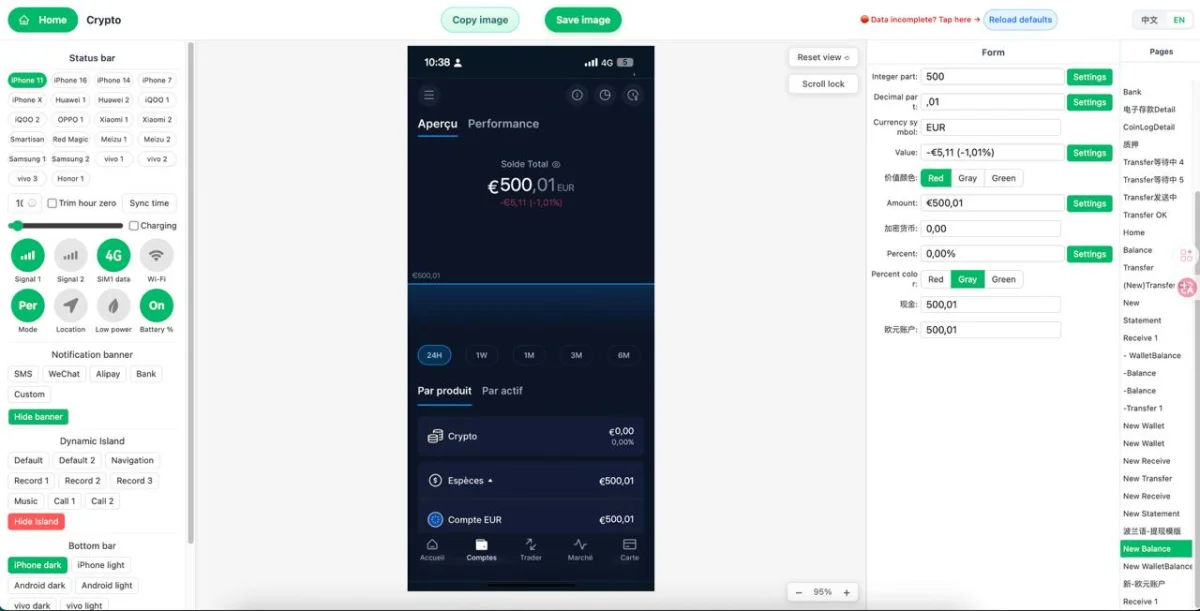
The editor loads with a live preview panel on the left and an editable form on the right. Every field you change updates the preview in real time:
- Balance field: Type in a token amount and label, for example "12.45 SOL"
- USD equivalent field: Enter the fiat conversion value
- Transaction history rows: Each row has fields for sender/recipient label, amount, timestamp, and status badge — add, remove, or reorder rows to match your target layout
- Token name and icon: Select or label the asset type displayed in the template
Status Bar Customization
Zoobic includes a built-in status bar editor that lets you adjust every detail in the device header:
- Clock time — set any time display you need
- Battery level — drag or type the percentage
- Signal bars and WiFi indicator — toggle and adjust independently
- Carrier/operator label — type a name or leave blank
- Dynamic Island support — available on applicable templates for modern device frames
Exporting Your Mockup as a PNG
All generated mockup images from Zoobic are intended for entertainment, learning, and research purposes only.
**What if I lose my recovery phrase?**Phantom displays a shortened version of your address in most views. The full ~44-character string is always accessible by clicking the address bar. Your address does not change unless you create a new account under the same seed phrase.
How do I add a custom token? Open the token list, scroll to the bottom, and select Add Custom Token. The form asks for the token's contract address. Paste the address, confirm the token name and symbol that auto-populate, and click Add.
Can I manage multiple wallets under one seed phrase? Yes. Phantom supports multiple accounts derived from the same recovery phrase. In the account switcher (top of the extension), click Add / Connect Wallet, then select Create a new account. Each account gets its own address and balance display.
What does "Simulated Transaction" mean? Phantom runs a transaction simulation before you approve certain operations. The simulation preview shows expected token changes before you commit. It's a security feature that helps you understand what a transaction will do.
| Screen | Key Fields | What to Enter | |---|---|---|| Recovery Phrase | 12 words | Write offline in order, store securely | | Verify Phrase | Selected word positions | Match your written record exactly | | Send | To address, Amount | Recipient public key, SOL or USD amount || Swap | From/To token, Slippage | Token symbols, percentage tolerance | | NFT Detail | Name, Attributes, Mint address | Read-only metadata display | | Settings | Auto-lock, Trusted apps | Idle timer, dApp permissions | | Mockup (Zoobic) | Balance, Address, Timestamp, Status | Sample values for demo or educational use |