What a fake Phantom balance mockup is for
A fake Phantom balance mockup is best understood as a visual demo asset, not as a record of a real wallet. In content production, the phrase often refers to a Phantom-style balance screen created as a screenshot template inside an online editor. The goal is to show a clean interface for storytelling, design review, teaching, or presentation use. A polished mockup helps creators communicate an idea quickly without building a full product screen from scratch.
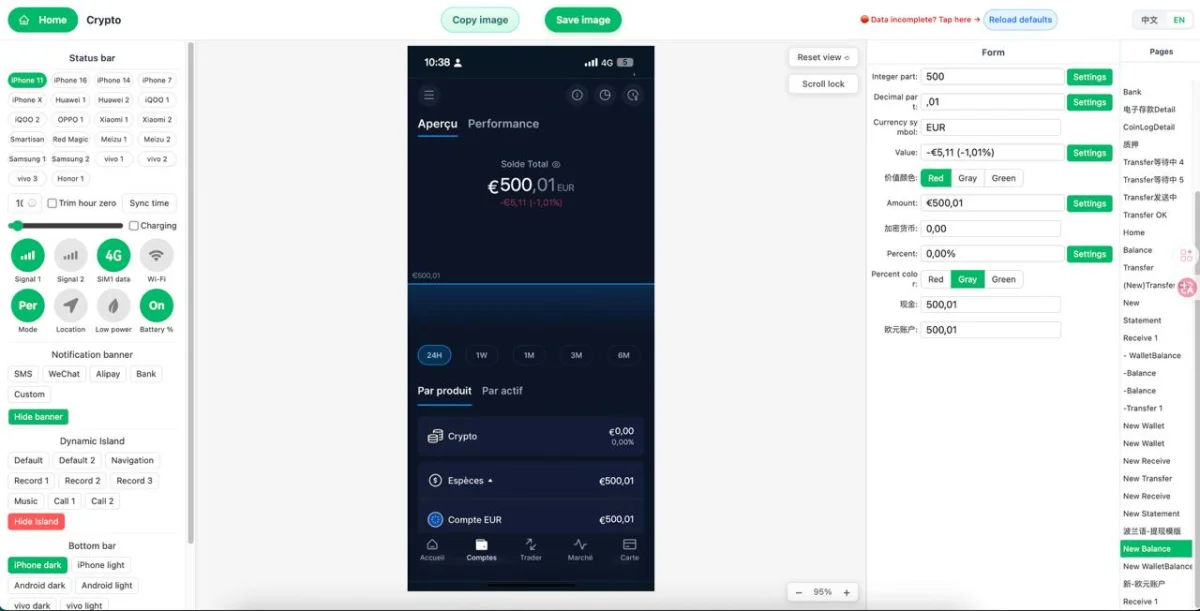
Zoobic is designed for exactly this process. It is an online editor with more than 8,000 templates across 300+ categories, including wallets, crypto interfaces, banking screens, chats, and e-commerce scenes. You open the template in the browser, view the live preview on the left, and edit fields in the form panel on the right. The structure is easy to understand even for non-designers, and the workflow is much faster than building a visual from zero.
Choose the best Phantom balance screenshot template
The quality of your final mockup depends heavily on the starting template. A strong Phantom balance screenshot template should already have the right visual hierarchy, device framing, and spacing before you edit anything. That saves time and helps the final screen look intentional. In practice, the best choice is not the most complex layout, but the one that matches your message with the fewest changes.
Start by searching Zoobic’s template library for wallet-style or crypto balance scenes. Because the platform supports keyword search and category browsing, you can filter quickly until you find a layout close to the screen you want. This matters for SEO and production value alike: a Phantom balance mockup works better when the structure already supports the balance figure, token rows, address area, and top navigation without overcrowding the screen.
Zoobic makes this stage efficient because the browser workflow is centered on speed. You do not need Photoshop, manual layers, or long setup. A smart template choice reduces later cleanup, shortens editing time, and improves consistency across multiple graphics. When the base structure already looks close to your target result, the rest of the online editor process becomes mostly field replacement and visual refinement. That is the real value of a high-quality screenshot template for clean Phantom-style demos.
Zoobic uses a form-based online editor, which is one of its strongest advantages. Instead of moving layers manually, you simply enter replacement text into structured fields and watch the preview update in the browser. This 改字换图 workflow is efficient for creators who need a fast turnaround. If a number looks too wide, a name feels too long, or a token label disrupts spacing, you can immediately adjust it and compare the result in the live preview.
This is also where Zoobic’s template system helps maintain consistency. If you create multiple versions for a blog, landing page, or presentation deck, you can keep the same structure and change only the essential fields. The result is a unified set of visuals built in the same online editor and exported through the same browser workflow. For teams that produce repeated wallet-themed visuals, that kind of efficiency is difficult to replace.
Make the screen realistic with status bar details
Zoobic includes status bar editing inside the same online editor, so you do not need another tool to polish these details. You can set the time, battery, signal indicators, and related visual cues directly in the browser while watching the live preview. This keeps the screenshot template workflow simple and efficient. It also helps creators maintain a consistent style across several mockup variations used in one article or campaign.
The best practice is subtlety. A status bar should support the screen, not compete with the balance figure. Choose values that feel ordinary and easy to read, then check whether the top portion of the interface still looks balanced. If the layout is already busy, keep the bar minimal. If the design is very sparse, these small details can add just enough realism without increasing clutter.
Language consistency also matters here. Since the article and target audience are in English, the final interface text should remain in English as well. That includes any visible date or system labels inside the screenshot template. Consistent language improves presentation quality and makes the mockup easier to use in English blog posts, social graphics, and educational decks. When the top bar, balance section, and asset rows all feel aligned, the Phantom balance mockup reads as a complete visual rather than a partially edited draft.
Clean up spacing before you export PNG
Zoobic’s live preview makes these refinements easy because every text edit appears instantly in the browser. Shorten labels that crowd the layout, simplify asset names that wrap awkwardly, and remove extra words that do not add meaning. This kind of cleanup is especially important in mobile screenshot template designs where every line competes for limited space. A cleaner composition improves both visual appeal and practical usability in thumbnails, slides, and article headers.
Do a final scan at normal viewing size before export. Make sure the largest number remains easy to read, the supporting rows are aligned, and the top bar does not feel disconnected from the rest of the design. Then export PNG and review the image once outside the editor. If anything feels off, return to the online editor, adjust the fields, and export PNG again. That short loop is one of the reasons browser-based screenshot template production works so well for fast content teams.
Build Phantom balance mockups for different demo scenarios
A mockup becomes stronger when it serves one clear scenario. Instead of trying to make one image do everything, build separate versions for separate goals. A Phantom balance mockup used in a product slide may emphasize the headline number and a tidy app frame, while one made for a tutorial cover may prioritize clarity and simpler secondary rows. A portfolio visual may place more emphasis on interface polish and composition.
Zoobic supports this workflow well because the same screenshot template can be adapted into several versions with minimal effort. You can duplicate the concept, keep the status bar style consistent, and change only the key details. For example, one version may feature a prominent balance figure for a landing page hero, another may use a more compact layout for a blog image, and a third may show a slightly richer asset section for a design case study.
Using one scenario per image also improves readability. The audience understands the message faster when the layout is focused. A screenshot template should support communication, not distract from it. If the screen is meant to explain a product concept, keep it minimal. If it is meant to enrich a tutorial article, add only the labels necessary for context. Zoobic’s 改字换图 structure makes these variations easy to manage while still keeping each mockup clean and export-ready.
Why Zoobic works well for Phantom balance mockup creation
Zoobic’s form panel is also well suited for routine content production. Balance amounts, names, timestamps, and other visible values can be changed quickly through structured inputs. The live preview on the left provides immediate feedback, which is especially useful when adjusting spacing-sensitive fields like long asset labels or large numbers. For many users, this is the practical sweet spot between a rigid generator and a full manual design tool.
Reuse one screenshot template across multiple visuals
Efficiency matters when you need more than one image. After you finish one strong Phantom balance mockup, the smartest move is to reuse the structure rather than start over. A proven screenshot template already solves the hardest visual questions: spacing, emphasis, framing, and hierarchy. Once those are in place, each additional variation requires only targeted edits to the balance, asset names, labels, or status bar details.
This is one of the most practical strengths of Zoobic. In the online editor, you can keep the same layout and create multiple outputs for different placements. A wider blog banner may need a simple balance-focused composition. A social card may require larger text and fewer secondary rows. A case study graphic may benefit from one or two extra details to show interface depth. All of these can be produced from the same browser workflow without rebuilding the design.
Consistency across visuals has real branding value. When related screenshots share similar spacing, status bar treatment, and typography, the final set feels more professional. Readers may not consciously notice every repeated design choice, but they do recognize coherence. That coherence supports stronger content presentation, especially when several graphics appear in the same article, deck, or landing page.
The best way to manage these variations is to change only what affects the message. Keep the core screenshot template stable, use 改字换图 edits for the important fields, review the preview for readability, and then export PNG for each version. This method saves time and preserves quality. It also helps maintain a clear SEO-aligned visual concept around the target phrase fake Phantom balance, while positioning the result correctly as a mockup for demos, learning materials, and creative content.
Key fields that make a Phantom-style screen believable
Not every template needs every field. In fact, adding too much information often weakens the visual. A screenshot template intended for a thumbnail may only need the balance, one asset row, and a simple header. A more detailed article illustration may benefit from an extra label or two. The right amount depends on the final use case, but the principle remains the same: every visible field should contribute to readability and the story of the mockup.
Zoobic makes field selection simple because the online editor exposes the editable parts clearly in the form panel. You can test a more minimal version, compare it in the browser, then add back only the details that improve the result. This trial-and-review loop is much easier than working in a manual layered design file. It also encourages cleaner output, since unnecessary lines are easy to spot in the live preview.
A believable Phantom balance mockup does not need to be overloaded to feel complete. It needs a clear main number, a recognizable wallet-style structure, a balanced status bar, and clean supporting text. When those elements align, the screenshot template looks polished and ready for blog visuals, slide design, teaching materials, or interface showcases. For entertainment and learning research only, this kind of focused editing produces the best results.
Final checklist before publishing the mockup
Before publishing or placing the image into a design, run a short review. First, confirm that the interface is fully in English and that no placeholder text remains. Then check that the balance figure is still the visual focal point and that any asset rows are readable at the size where the image will actually appear. If the screenshot template will be used as a thumbnail, test whether the main number still stands out when scaled down.
Next, review spacing and alignment one more time in the browser. Zoobic’s online editor makes last-minute changes easy, so there is no need to settle for crowded labels or awkward line breaks. If the top bar feels too heavy, simplify it. If a secondary field adds clutter, remove it. Then export PNG and compare the final file with the in-editor preview to make sure the mockup remains sharp and balanced.
A final practical reminder is to keep usage aligned with presentation, content creation, and study scenarios. A Phantom balance mockup works best as a visual communication asset for demos, learning, and design storytelling. With Zoobic, the process stays simple: choose a screenshot template, edit in the online editor, polish the details in the browser, and export PNG when the layout is ready. For entertainment and learning research only, please do not use it for illegal purposes.